13 August 2026
Obtain Permanent Residence in Switzerland
Obtaining Swiss B and C residence permits is not complicated. Our lawyers can help you immigrate to Switzerland, so contact us.
Our immigration lawyer presents the main routes to obtain permanent residency in Switzerland for EU and non-EU citizens. You can rely on us for assistance in obtaining a residence permit in Switzerland.
| Quick Facts | |
|---|---|
| Entry visa requirement (YES/NO) | YES, for non-EU citizens |
Types of visas for permanent residency | L permits, B permits for temporary residence |
Permanent residency by employment availability (YES/NO) | YES, provided that a job is secured prior to entering the country |
| Permanent residence through temporary relocation requirements | YES, by obtaining a B permit that can be renewed |
| Temporary residence permit validity | Usually 1 year (renewable) for non-EU/EFTA citizens; 5 years for EU/EFTA citizens with an employment contract of at least 1 year |
| Direct permanent residency possibility (YES/NO) | NO |
| Living requirements to obtain permanent residence | 5 years for citizens of EU-15/EFTA states with settlement agreements, 10 years for others (5 years possible with good integration) |
| Permanent residency by investment option (YES/NO) | NO dedicated route; investors and lump-sum taxpayers follow the general 10-year rule (5 years for certain EU/EFTA nationals) |
| Timeframe to obtain permanent residence (approx.) | 2 – 4 months |
| Relocation with family members possibility (YES/NO) | YES, through family reunification (each family member receives his/her own permit) |
| Possibility to sponsor family members for immigration (YES/NO) | YES, permanent residents can bring their spouses/registered partners and children under 18 |
| Citizenship requirements through permanent residency | 10 years of residence with a C permit at the time of application; 5 years for spouses of Swiss citizens (simplified naturalisation) |
| Advantages of obtaining a permanent residency | Access to a competitive labor market, possibility to start a business, high living standards, possibility to acquire a property |
| Support in obtaining permanent residency (YES/NO) | YES |
| Other immigration services | Assistance in applying for all types of visas, support in renewing residence permits, guidance on obtaining citizenship |
| Possibility to acquire permanent residency through marriage visa (YES/NO) | Switzerland does not have a marriage visa, however, family reunion can be used by a foreign spouse to move here. |
Sponsorship requirements for family members (if any) | Yes: living together, suitable housing, sufficient financial means without social assistance and, for spouses, A1 oral language skills (or enrolment in a course). |
Business immigration availability (YES/NO) | Yes, foreigners can move to Switzerland by starting a business. |
| Access to residency based on retirement (YES/NO) | Yes, retirees aged 55 and more can apply for residency in Switzerland. |
| Special requirements by country of origin (if any) | Permanent residence requires different living requirements for EU/EFTA and non-EU/EFTA citizens. |
| Quota-based immigration to Switzerland (YES/NO) | Yes, however, this is available for employment-based relocation only. |
| Conditions to qualify for permanent residency (if any) | – clean criminal record; – having lived in Switzerland for the required period of time; – possessing a valid residence permit (Swiss B permit) at the time of the application. |
| Language requirements when applying for residency (YES/NO) | Yes, at least A2 (oral) and A1 (written) in the national language of the place of residence (B1/A1 for an early C permit). |
| Safest way to obtain a Swiss C permit | Employment |
| Easiest way to obtain permanent residency | Employment or business |
| Best cities to live in Switzerland | – Bern; – Geneva; – Zurich; – Winterthur, etc. |
| Authorities to file immigration papers with | Cantonal authorities |
| Special residency requirements based on canton (YES/NO) | Yes, cantons decide on permits and apply their own practices (e.g., integration interviews) within federal law. |
| Loss of permanent residency | – having committed criminal offenses; – having lied to obtain residency; – being a threat to national security, etc. |
| Support in residence permit refusal (YES/NO) | Yes, we can also offer support in case of residence permit rejection. |
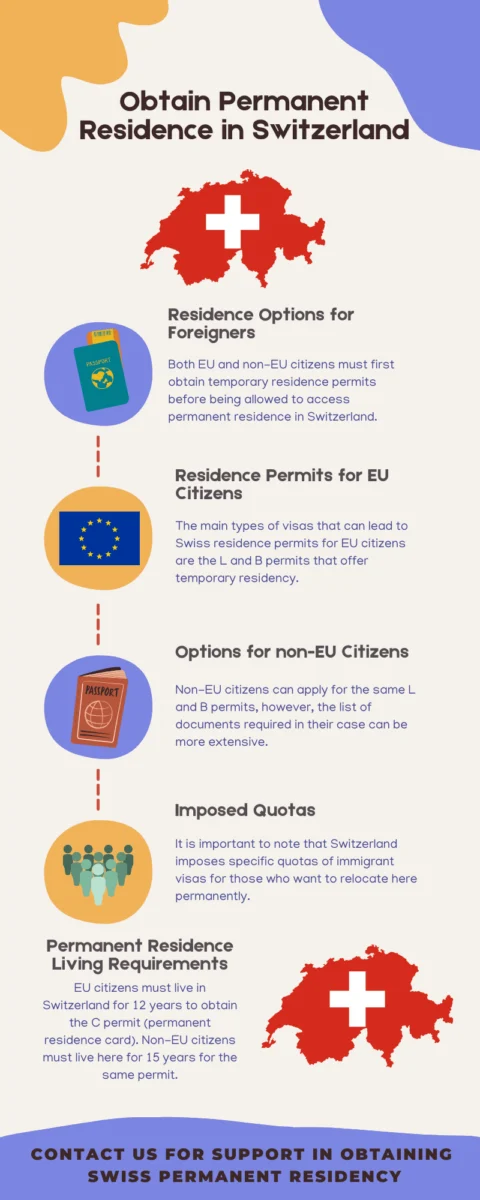
What are the types of Swiss residence permits I can obtain as a foreigner?
Here are the main types of residence permits available for both EU and non-EU citizens:
- the L permit, which can be obtained by both EU and non-EU citizens for limited periods of time;
- the B permit, which also applies to both categories of applicants, has an extended period of stay;
- the C permit, which is the residence permit that enables EU and non-EU citizens to settle in Switzerland;
- the G permit, which can be obtained by those who commute for work from another country to Switzerland.
In the case of non-EU citizens, it is important to first hold a permanent residence permit in a neighbouring country (and live in its border zone for 6 months) in order to obtain a G permit, however, this type of residence visa is usually requested by citizens living in European countries bordering Switzerland and commuting on a weekly basis.
What are the requirements I need to meet to move to Switzerland?
As a foreign citizen, you can relocate to Switzerland under the following conditions:
- you have a job offer from a Swiss company;
- you start a business in Switzerland;
- you marry a Swiss citizen.
No matter the option, non-EU/EFTA citizens must obtain an authorisation (and a national D visa where required) before entering the country. The procedure must begin in your country of residence.
What are the main requirements to obtain permanent residency in Switzerland?
The general conditions are:
- living in Switzerland lawfully based on a B permit (temporary residence card);
- have basic language knowledge (based on the canton you live in);
- be self-sufficient (you must not have been living on social welfare);
- have a clean criminal record.
What is the minimum living requirement to obtain a permanent C permit in Switzerland?
5 or 10 years, depending on your nationality, or if other conditions apply.
Who can benefit from the 5-year living requirement to obtain Swiss permanent residence?
The following categories of immigrants:
- citizens of EU/EFTA states with settlement agreements (Austria, Belgium, Denmark, Finland, France, Germany, Greece, Ireland, Italy, Luxembourg, Netherlands, Portugal, Spain, Sweden, Iceland, Liechtenstein, Norway);
- UK, US and Canadian citizens only if they qualify through good integration;
- foreign citizens married to Swiss nationals;
- foreign citizens who are well integrated (B1 oral and A1 written language skills).
What are the documents I need to submit to obtain a Swiss residence permit?
Candidates should consider the following:
- specific forms issued by each cantonal authority;
- proof of health insurance;
- employment contract (where applicable);
- proof of residential address.
Other documents may be requested based on specific conditions.
Where do I submit my permanent residence application in Switzerland?
With the cantonal immigration office where you live. Then, the documents related to moving to Switzerland and obtaining permanent residence are processed by the State Secretariat for Migration.
IMPORTANT! Submit the application PRIOR to the expiration of the temporary residence card. Also, make sure you meet the permanent residence eligibility requirements before doing so. You can consult with our Swiss immigration lawyers for guidance in this sense.
Are there any cantonal requirements that apply when filing for a Swiss C permit?
Yes, certain cantonal authorities require passing an interview or evaluation for social integration.
You can also watch our video below:

How long does it take to have a C permit issued in Switzerland?
The procedure varies from canton to canton and can take up to 3 or 4 months.
What are my rights as a permanent resident in Switzerland?
As a permanent resident, the most important right is the possibility of choosing where you live and work. You can also relocate from one canton to another without additional permissions, which is not the case for Swiss B permit holders.
Can I lose my permanent resident status in Switzerland?
Yes, there are grounds for losing this status. For example, leaving the country for a long period without notifying the authorities or committing a serious crime will lead to it.
If you need immigration assistance in another country, such as Romania, we recommend our partners – ImmigrationRomania.Lawyer.
If you are a foreign citizen from an EU or non-EU country and want to obtain Switzerland permanent residence, you can rely on our immigration lawyers for personalized advice and support, so do not hesitate to contact us. We can also guide you in applying for Switzerland citizenship.